
A photograph is not frozen time—it's an invitation to step back into ourselves.
What is a memory? Is it a fleeting thought, a distant echo of the past? Or is it something more tangible, something that can be held and cherished? For many of us, our memories are intrinsically linked to photographs. A single image can transport us back in time, to a moment of joy, of love, of loss.

Photos are more than just pictures; they are the building blocks of our identity. They tell the story of who we are, where we’ve been, and what we’ve experienced. They are a visual representation of our life’s journey, a collection of moments that have shaped us into the people we are today.
The Science Behind Why Photos Move Us
Neuroscience offers a compelling explanation for the emotional weight of photographs. When we look at an image from our past, the brain does not merely retrieve a stored file. It reconstructs the moment. The hippocampus — the region responsible for memory formation — activates alongside the amygdala, which processes emotion. That is why a single photograph can simultaneously bring tears and a smile. The image is not just visual data; it is a chemical event, a brief re-immersion in the feelings of the original experience.
Researchers at the University of California found that viewing personal photographs activates brain regions associated with self-reflection and emotional processing far more intensely than viewing images of strangers or generic scenes. In other words, a photo of a foreign street corner means nothing to most people, but if that corner is where you kissed someone for the first time, it lights up your brain like a small storm.
This is also why physical photographs — the kind you can hold, pass around a table, pin to a wall — tend to carry more emotional weight than their digital counterparts. There is something about the tangibility of a printed image, its fixed size, its slight imperfections, that makes the memory feel more real. The same principle applies to any physical object tied to a place: a postcard, a souvenir, or a three-dimensional relief of a city where something important happened to you.
Places as Memory Anchors
We tend to think of memory as being about people and events. But place plays a quieter, deeper role. The apartment where you grew up. The park where you learned to ride a bicycle. The city where you spent your university years. These places become anchors — fixed coordinates in the shifting geography of a life.
Psychologists call this “place attachment,” and it is one of the most studied phenomena in environmental psychology. The bond between a person and a meaningful location shapes identity, provides a sense of continuity, and offers comfort during periods of change. When you move to a new city, it is often the places you left behind — not just the people — that you miss most acutely. The light falling through a particular window. The sound of a street you walked every day.

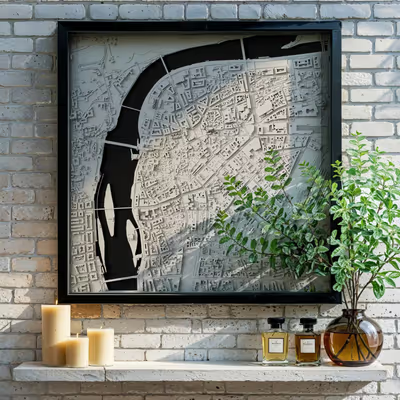
Photographs capture these places, but they capture them flat. A photo of Edinburgh’s Old Town shows you what it looks like, but it cannot show you the way the streets rise and fall, the way the castle sits above the city on its volcanic rock, the way the closes wind between the buildings. For that, you need something with dimension — something that gives the place back its physical presence.
The Difference Between Storing and Honoring a Memory
There is a meaningful distinction between storing a memory and honoring it. We store memories by the thousands on our phones, in cloud accounts, on hard drives we rarely open. These memories are safe, in the technical sense, but they are also invisible. They live behind screens and passwords, surfacing only when an algorithm decides to remind us.
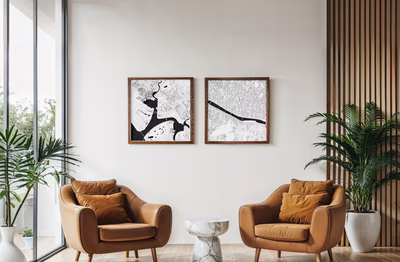
Honoring a memory is a deliberate act. It means choosing a moment — or a place — and giving it a physical presence in your daily life. A framed photograph on a mantelpiece. A handwritten letter kept in a drawer. A city relief mounted on a wall, showing the streets where your story unfolded.
When we look at a photo, we are not just seeing an image; we are reliving a memory. We are reconnecting with a part of ourselves that we may have forgotten. We are reminded of the people we have loved, the places we have been, and the dreams we have had.
The act of framing something — literally placing it inside a border and hanging it where you will see it every day — elevates it. It says: this matters. This is not just data to be archived. This is a piece of who I am.
How Our Relationship with Photos Has Changed
The way we take and share photographs has changed dramatically in the past two decades. The average person now takes more photographs in a year than their grandparents took in a lifetime. We document meals, sunsets, outfits, and street corners with the casual frequency of breathing. And yet, paradoxically, we look at individual photographs less.
The volume has diluted the attention. When every moment is captured, no single capture feels significant. Scroll past a hundred images on your phone and you might feel a vague sense of recognition, but rarely the sharp emotional hit that comes from discovering a single print in a shoebox.
This is not an argument against digital photography. It is an argument for curation — for choosing the moments and places that matter most and giving them a form that commands attention. A printed photograph, carefully selected and thoughtfully framed, does something that a camera roll of ten thousand images cannot. It slows you down. It asks you to look.

The Gallery Wall: Telling Your Story in Frames
One of the most enduring interior design traditions is the gallery wall — a curated arrangement of framed images, prints, and objects that tells a visual story. Done well, a gallery wall is autobiography in miniature. It shows the viewer where you have been, what you value, and how you see the world.
The key to a compelling gallery wall is variety. Mix photographs with other visual forms: a sketch from a trip, a pressed flower from a garden, a three-dimensional city relief showing the streets of a place you love. The interplay between flat and dimensional objects creates visual depth and draws the eye across the arrangement.
Consider organizing your gallery wall thematically rather than chronologically. A wall dedicated to the cities that have shaped your life — Paris, Bucharest, Edinburgh, Florence — tells a different story than one arranged by year. Each approach has its power, but the thematic wall tends to spark more conversation, because visitors can see the thread that connects the pieces.
Why Physical Objects Matter in a Digital World
We live in an era of abundant digital content and scarce physical presence. Our photographs live in the cloud. Our music is streamed. Our books are downloaded. There is nothing wrong with any of this — convenience and accessibility are genuine improvements. But something is lost when every meaningful artifact is reduced to pixels on a screen.
Physical objects occupy space. They catch light. They age. A wooden frame develops a patina over the years. A printed photograph yellows slightly at the edges. These changes are not flaws; they are evidence of time passing, of a life being lived around the object. A 3D city relief mounted on your wall will gather the subtle marks of years — a trace of dust in a contour, a slight warmth to the wood from decades of sunlight — and those marks become part of its story.
This is why the impulse to print, to frame, to mount something on a wall is not merely decorative. It is an act of resistance against the weightlessness of digital life. It says: this place was real. This memory has weight. I want to see it every morning when I walk through this room.
Rediscovering Your Past
So take the time to look through your old photos. Reconnect with your past, and rediscover the stories that have made you who you are. Open the shoeboxes, the albums, the forgotten folders on your desktop. Look for the images that stop you — the ones where you can still feel the temperature of the air, still hear the background noise, still remember exactly what happened in the seconds after the shutter clicked.
And when you find a photo that speaks to you, give it the place of honor it deserves. Frame it, display it, and let it be a constant reminder of the beautiful journey that is your life. If the memory is tied to a city — a place that shaped you, that holds a chapter of your story — consider giving that place a physical form on your wall. Not just as a photograph, but as a dimensional object that captures the actual geography of where your memory lives.
Because a memory that you can see every day is a memory that stays alive. And a place that you can touch — that you can run your fingers across and feel the streets and contours beneath them — is a place that never fully lets you go.



Key highlights
Captured Moments
A single photo can transport you decades into the past
Emotional Anchors
Photos connect us to people and places we cherish
Memory Preservation
Framing protects and elevates our precious memories
Identity Building
Our visual history shapes who we become
Memory markers
Attic box of prints
Smudged edges, penciled dates, and the scent of dust and perfume.
Train window reflection
Catching your younger self staring back during a late-night ride home.
Living room wall
The place you glance every morning to remember who you're carrying forward.
Take this feeling home
Frame Your Memories
Transform your cherished city memories into a tactile piece of art you can touch and feel