
Edinburgh isn't just a destination—it's an experience that stays with you long after you've left.
Edinburgh: Where History Meets Modernity
Edinburgh, the capital of Scotland, is a city that effortlessly blends the old with the new. From its medieval castle dominating the skyline to its cutting-edge festivals and cultural institutions, Edinburgh offers a unique experience that captivates visitors from around the world. It is one of those rare cities where you can stand in a single spot and see eight centuries of architecture without turning your head.

The Castle and the Royal Mile
No visit to Edinburgh is complete without exploring Edinburgh Castle, perched dramatically on Castle Rock. This iconic fortress has stood guard over the city since the 12th century and houses the Scottish Crown Jewels and the Stone of Destiny — the ancient coronation stone returned to Scotland in 1996 after seven hundred years in Westminster Abbey.
Walking down the Royal Mile from the castle to the Palace of Holyroodhouse, you pass countless historic sites, pubs, and shops. This ancient thoroughfare tells the story of Edinburgh’s past, from its days as a royal residence to its role in the Scottish Enlightenment. The mile is actually 1.12 miles long, and every few steps you will notice a narrow passageway — a “close” — branching off between the buildings. These closes were the arteries of medieval Edinburgh, and many of them still bear the names of the tradespeople who once worked there: Fleshmarket Close, Advocate’s Close, Bakehouse Close.
Take the time to wander into at least a few. Riddle’s Court, halfway down the Lawnmarket section, leads to a beautifully restored sixteenth-century courtyard. Dunbar’s Close hides a formal garden that feels completely removed from the tourist bustle just meters away. These small detours are where Edinburgh reveals its quieter character — the layers beneath the postcard views.
At the foot of the Royal Mile stands the Palace of Holyroodhouse, the official Scottish residence of the British monarch. The palace’s Great Gallery contains 96 portraits of Scottish monarchs, all painted by Jacob de Wet in a single two-year commission. Whether they bear any resemblance to the actual kings is debatable, but the sheer ambition of the project is impressive. The adjacent ruins of Holyrood Abbey, roofless since 1768, are hauntingly beautiful at any time of day.
Arthur’s Seat and Natural Beauty
For breathtaking views and a touch of adventure, hike up Arthur’s Seat in Holyrood Park. This extinct volcano offers panoramic vistas of the city and the surrounding countryside. On a clear day, you can see for miles across the Firth of Forth to the Kingdom of Fife.
The climb to the 251-meter summit takes roughly 45 minutes from the palace entrance, and the path is well-trodden but uneven in places — sturdy shoes are recommended. What makes the experience remarkable is not just the view from the top, but the way the city seems to shrink as you climb. Edinburgh’s volcanic topography is part of its identity; the city was built around, between, and on top of geological features that most urban planners would have considered obstacles. Arthur’s Seat, the Castle Rock, Calton Hill, and the Crags together create a skyline that no amount of modern construction could replicate.
For a gentler walk with equally rewarding views, try Calton Hill on the eastern end of Princes Street. The hilltop is home to the National Monument — an unfinished replica of the Parthenon that earned Edinburgh the nickname “Athens of the North” — and the Nelson Monument, which offers 360-degree views of the city, the Firth of Forth, and the Pentland Hills to the south.
The Old Town and the New Town: A Tale of Two Cities
Edinburgh’s dual identity is most visible in its UNESCO World Heritage Site, which encompasses both the medieval Old Town and the Georgian New Town. These two districts sit on either side of Princes Street Gardens — a public park that occupies the drained bed of the old Nor Loch — and they could hardly be more different.
The Old Town is dense, vertical, and organic. Buildings rise to ten or twelve stories along the Royal Mile, and the street plan follows the ridge of the volcanic crag with little regard for geometric order. In the medieval period, Edinburgh was one of the most densely populated cities in Europe, and the vertical building tradition was a direct response to the limited space within the city walls.
The New Town, by contrast, is a masterpiece of eighteenth-century urban planning. Designed by the young architect James Craig in 1767, it features a grid of broad streets, symmetrical facades, and elegant crescents. Walking from the Old Town to the New Town is like stepping from one century into another, and the transition happens in the space of a few hundred meters.
Cultural Festivals and Events
Edinburgh is renowned for its festivals. The Edinburgh Festival Fringe, the world’s largest arts festival, transforms the city every August with thousands of shows across all art forms. In a typical year, the Fringe hosts over 3,000 shows across more than 300 venues — from grand theaters to the back rooms of pubs, from converted churches to the inside of a taxi. The International Festival, which runs concurrently, curates a more selective program of theater, opera, music, and dance at the city’s major venues.
But August is not the only festival season. Hogmanay, Edinburgh’s New Year celebration, is one of the largest street parties in the world, with fireworks launched from the castle ramparts. The Edinburgh International Book Festival in August brings together hundreds of authors for readings and discussions. The Royal Edinburgh Military Tattoo, held on the castle esplanade, combines military precision with theatrical spectacle against one of the most dramatic backdrops in Europe.
A Literary City
Edinburgh was designated the world’s first UNESCO City of Literature in 2004, and the title is well earned. This is the city that produced Robert Louis Stevenson, Arthur Conan Doyle, and Walter Scott, whose enormous monument on Princes Street is the largest memorial to a writer anywhere in the world. J.K. Rowling wrote much of the early Harry Potter series in Edinburgh’s cafes, and the city’s graveyards provided several character names — Tom Riddle among them.
The literary heritage is not just historical. Edinburgh supports a thriving community of contemporary writers, independent bookshops, and literary events. The Scottish Poetry Library, tucked into a beautifully designed building near the Royal Mile, is free to visit and worth the detour.
Modern Edinburgh
Beyond its historic charm, Edinburgh boasts a thriving contemporary scene. The Scottish National Gallery houses an impressive collection of art spanning the early Renaissance to the Post-Impressionists, while the National Museum of Scotland on Chambers Street offers interactive exhibits on Scottish history, science, and culture across seven floors.
The city is also home to a growing tech sector, with companies and startups making Edinburgh a hub for innovation in Scotland. The area around Leith, Edinburgh’s port district, has undergone significant regeneration over the past two decades. Once a gritty dockland, Leith now hosts some of the city’s best restaurants — including several Michelin-starred establishments — alongside creative studios, craft breweries, and waterfront apartments. A walk along the Water of Leith from Stockbridge to the Shore reveals a side of Edinburgh that many visitors never discover.
Edinburgh’s Dramatic Topography
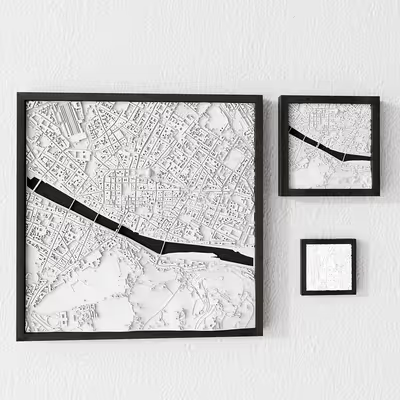
One of the things that makes Edinburgh visually extraordinary is its topography. The city is built on a series of volcanic hills and glacial formations that create a skyline of dramatic ups and downs. Castle Rock, Arthur’s Seat, Calton Hill, the Salisbury Crags — these geological features give the city a three-dimensional character that flat cities simply cannot match.
This is precisely why Edinburgh translates so well into a 3D city relief. The volcanic ridges, the river valleys, the sudden elevation changes between the Old Town and the New Town — all of these become legible when the city is rendered in three dimensions. Looking at an Edinburgh relief, you can trace the path of the Royal Mile along the ridge, see how the castle sits on its volcanic plug, and understand why the New Town was built on the parallel ridge to the north. It is a way of seeing the city’s structure that no flat map or photograph can provide.
Why Edinburgh Captivates
What makes Edinburgh so special is its ability to honor its past while embracing the future. The city’s architecture tells stories of resilience and reinvention, from the narrow closes of the Old Town to the elegant Georgian streets of the New Town.
Whether you are drawn to history, culture, nature, or simply the magic of a city that feels alive with possibility, Edinburgh offers something for every traveler. It is a place where you can walk in the footsteps of kings and queens one moment, and enjoy a craft beer in a modern pub the next. It is compact enough to explore on foot, dramatic enough to photograph from every angle, and layered enough to reward a second, third, or tenth visit.
Planning Your Edinburgh Adventure
- Best Time to Visit: June to August for the best weather and festivals; December for Hogmanay and winter atmosphere
- Getting Around: Walk the historic areas, use buses for longer distances; a day pass on Lothian Buses is excellent value
- Local Tips: Try haggis at a traditional pub, visit during festival season, explore the underground vaults beneath the South Bridge
- Hidden Gems: The Real Mary King’s Close, Dean Village, the Camera Obscura, Dunbar’s Close Garden, the Vennel steps for a framed view of the castle
- Budget Tip: Many of Edinburgh’s best experiences are free — climbing Arthur’s Seat, walking the Royal Mile, visiting the National Museum, and exploring the New Town’s Georgian architecture cost nothing
Edinburgh is not just a destination — it is an experience that stays with you long after you have left. It is a city that reminds us that the past and present can coexist beautifully, creating something truly extraordinary.
Key highlights
Medieval Old Town
UNESCO World Heritage Site with centuries of history
Festival Capital
Home to the world's largest arts festival
Natural Beauty
Arthur's Seat and Holyrood Park within the city
Scottish Culture
Whisky, haggis, and warm Highland hospitality
Memory markers
Edinburgh Castle
Ancient fortress perched dramatically on volcanic rock since the 12th century
Royal Mile
Historic thoroughfare connecting castle to palace
Arthur's Seat
Extinct volcano offering panoramic city views
Old Town
Medieval architecture and hidden closes waiting to be explored
Take this feeling home
Capture Edinburgh Forever
Our Edinburgh relief brings the castle, Royal Mile, and Old Town to your wall