Florence is not just a city—it's a living museum where every stone whispers stories of artistic revolution.
Florence: Birthplace of the Renaissance
Florence, the capital of Tuscany, is more than just a city — it is a living museum of Renaissance art and architecture. For over 500 years, this compact Italian city has been the cradle of artistic innovation, producing some of the world’s most celebrated masterpieces and influencing art movements that shaped Western civilization. Within its relatively small historic center — walkable end to end in under an hour — Florence contains more UNESCO-recognized cultural heritage per square meter than almost anywhere else on earth.
The Duomo and Baptistery
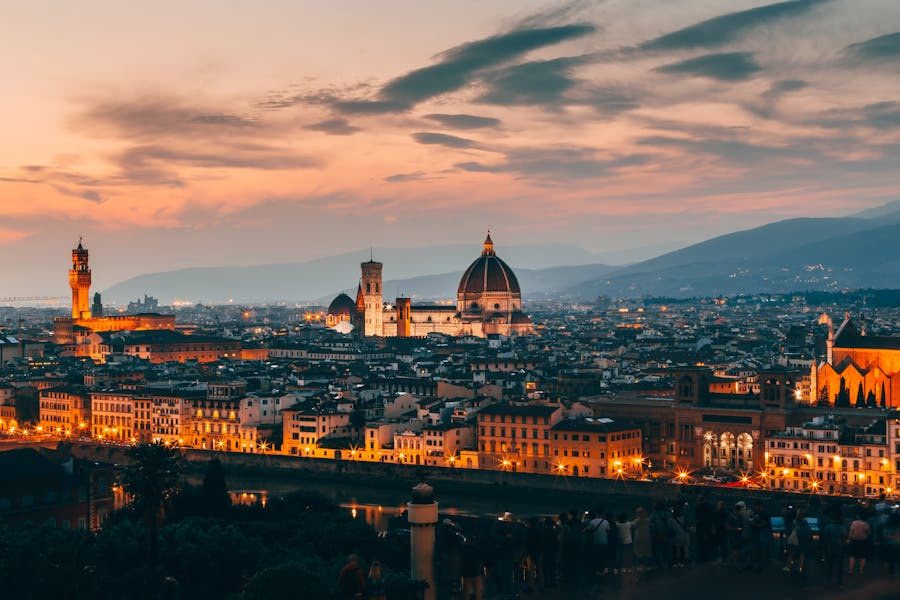
The centerpiece of Florence is the magnificent Duomo, officially known as the Cathedral of Santa Maria del Fiore. This Gothic masterpiece, with its iconic red-tiled dome designed by Filippo Brunelleschi, dominates the city’s skyline. Climb the 463 steps to the top for breathtaking views of the city and the surrounding Tuscan hills.
The dome itself is an engineering marvel that remains astonishing nearly six centuries after its completion. When Brunelleschi won the competition to design it in 1420, no one had built a dome of comparable size since the Roman Pantheon. His solution — a double-shell structure built without centering scaffolding — was considered impossible by many of his contemporaries. He invented new construction techniques and even designed custom hoisting machines to lift materials to the required height. The dome took 16 years to complete and remains the largest masonry dome ever constructed.
Adjacent to the Duomo stands the Baptistery of St. John, famous for its bronze doors. The east doors, known as the “Gates of Paradise,” were crafted by Lorenzo Ghiberti over a period of 27 years and are considered one of the greatest achievements of Renaissance sculpture. Michelangelo himself reportedly said they were worthy of being the gates of paradise — though whether he actually said this or whether the attribution is apocryphal is a matter of scholarly debate. The originals are now housed in the Museo dell’Opera del Duomo to protect them from the elements, while faithful replicas stand in their place.
Michelangelo’s David and the Accademia Gallery
No visit to Florence is complete without seeing Michelangelo’s David at the Accademia Gallery. This 17-foot marble statue, carved from a single block of Carrara marble, represents the pinnacle of Renaissance sculpture. The block itself had been abandoned by two previous sculptors who considered it too narrow and flawed to work with. Michelangelo, just 26 years old at the time, spent over two years transforming it into what many consider the greatest sculpture ever created.
The gallery also houses Michelangelo’s unfinished Prisoners — four figures that appear to be struggling to free themselves from the raw stone. Whether Michelangelo left them deliberately incomplete as an artistic statement or simply moved on to other commissions is still debated. Either way, they offer a rare glimpse into the sculptor’s working process and the extraordinary vision required to see a finished form within an uncut block of marble.
The Uffizi Gallery
Housed in a beautiful Renaissance palace designed by Giorgio Vasari, the Uffizi Gallery contains one of the world’s most important collections of Renaissance art. Here you will find works by Leonardo da Vinci, Michelangelo, Raphael, Botticelli, and countless other masters.
Botticelli’s Birth of Venus and Primavera alone justify the visit. But the Uffizi rewards those who move beyond the most famous rooms. The Caravaggio works on the upper floors, the collection of ancient Roman sculptures, and the views from the terrace cafe overlooking the Piazza della Signoria are all worth lingering over. Budget at least three hours — more if you are genuinely interested in art history.
A practical note: the Uffizi’s popularity means that queues can stretch for hours during peak season. Booking a timed-entry ticket online, days or even weeks in advance, is essential between April and October. Early morning slots tend to be less crowded, and the light in the galleries is beautiful before the afternoon sun begins to glare through the windows.
Piazza della Signoria
This open-air sculpture gallery in the heart of Florence features replicas of famous works including Michelangelo’s David, Donatello’s Judith and Holofernes, and Giambologna’s Rape of the Sabine Women. It is a perfect spot to people-watch and soak in the city’s artistic atmosphere.
The piazza also holds the Loggia dei Lanzi, an open-air gallery of remarkable sculptures that you can view at any hour, free of charge. Cellini’s bronze Perseus, holding the severed head of Medusa, is among the finest bronze statues in existence. The Loggia is one of those rare places where world-class art sits in open air, accessible to anyone who happens to walk by.
The Palazzo Vecchio, Florence’s town hall since the thirteenth century, anchors the southern side of the piazza. Its crenellated tower rises 94 meters above the square and is visible from almost anywhere in the city. The interior contains frescoed halls, secret passages, and a room painted by Vasari that is said to conceal a lost Leonardo da Vinci masterpiece behind its walls.
Ponte Vecchio and the Arno River
The Ponte Vecchio, or “Old Bridge,” is Europe’s oldest stone arch bridge still standing. Originally built in 1345, it has been lined with shops since the 15th century. The bridge was originally home to butchers and tanners, but in 1593 Grand Duke Ferdinand I decreed that only goldsmiths and jewelers could operate there — a tradition that continues to this day.
Walk across it at sunset for magical views of the Arno River and the surrounding hills. Above the shops runs the Vasari Corridor, a private elevated passageway built in 1565 to allow the Medici family to walk from the Palazzo Vecchio to the Palazzo Pitti without descending to street level. The corridor, which contains a remarkable collection of self-portraits by artists across the centuries, has recently been reopened to visitors after years of restoration.
The Oltrarno: Florence’s Left Bank
Cross the Ponte Vecchio and you enter the Oltrarno — literally “beyond the Arno” — a neighborhood that feels distinctly different from the tourist-heavy streets north of the river. This is where Florentine artisans still work: leather craftsmen, furniture restorers, bookbinders, and mosaic artists operate from workshops that have changed little in generations.
The Palazzo Pitti, once the residence of the Medici and later the Italian royal family, houses several museums and the stunning Boboli Gardens behind it. The gardens, designed in the sixteenth century, climb the hillside in a series of terraces, grottos, and fountains. From the upper terrace, the view back across the rooftops toward the Duomo is one of the finest in Florence.
The Oltrarno’s Piazza Santo Spirito hosts a morning market and is surrounded by unassuming restaurants that serve some of the best food in the city — at prices significantly lower than those near the Duomo. If you want to eat where Florentines eat, this is where to come.
Tuscan Cuisine
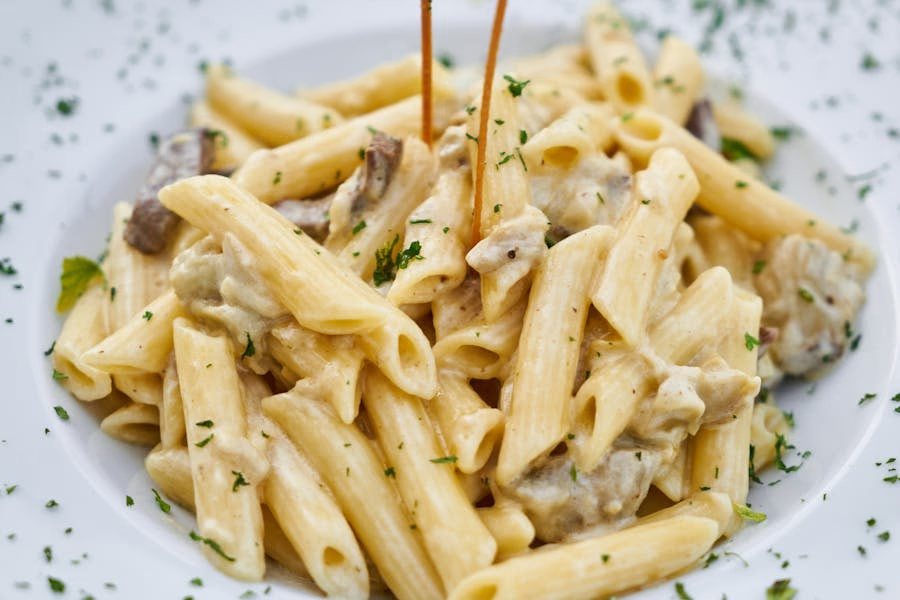
Florence offers some of Italy’s finest cuisine. Tuscan cooking is built on a philosophy of simplicity: excellent ingredients, minimal interference, and respect for tradition. The bread is famously unsalted — a tradition dating back to a twelfth-century trade dispute with Pisa — which makes it a perfect vehicle for the bold flavors of local olive oil, cured meats, and aged cheeses.
Do not miss trying authentic Tuscan dishes like ribollita, a thick vegetable and bread soup that improves with each reheating; bistecca alla fiorentina, a massive T-bone steak grilled over chestnut wood and served rare; and cantucci, hard almond biscotti designed to be dipped in vin santo, a sweet dessert wine. For street food, try lampredotto — a tripe sandwich that is a Florentine institution — from one of the city’s traditional food carts.
Pair your meals with local wines. Chianti Classico, Brunello di Montalcino, and Vino Nobile di Montepulciano are all produced within easy reach of the city. Many restaurants offer house wines by the carafe that are remarkably good and remarkably affordable.
Florence’s Urban Form
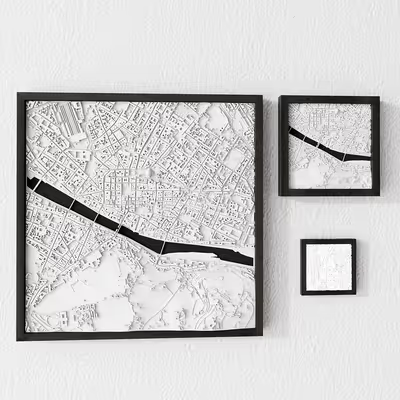
What makes Florence visually distinctive — beyond its individual landmarks — is its remarkably coherent urban form. The historic center is compact, largely flat, and organized around a clear grid of streets that has changed little since the Renaissance. The terracotta roofscape, visible from any elevated viewpoint, creates a warm, unified palette that few cities can match.
The Arno River cuts through the center, and the hills of Fiesole and the Oltrarno rise gently on either side. This combination of flat river plain and surrounding elevation gives Florence a three-dimensional character that is particularly striking when viewed from above — or when rendered as a physical relief. The streets, the river bend, the dense blocks of the historic center, and the green spaces of the Boboli Gardens all become legible in a way that captures the city’s essential geography.
Day Trips from Florence
- Pisa: Visit the Leaning Tower and the beautiful Piazza dei Miracoli (about 1 hour by train)
- Siena: Explore this medieval hill town and its stunning shell-shaped piazza (about 1.5 hours by bus)
- Chianti Region: Wine tasting in the rolling Tuscan countryside, with stops at centuries-old estates
- Cinque Terre: Five dramatic coastal villages connected by hiking trails (about 2.5 hours by train)
- San Gimignano: A hilltop town famous for its medieval towers and world-class gelato
Practical Tips for Visiting Florence
- Best Time to Visit: April to June or September to October for milder weather and thinner crowds
- Getting Around: Walk the historic center — it is compact and flat; use buses for Fiesole or Piazzale Michelangelo
- Tickets: Book Uffizi and Accademia tickets well in advance; consider the Firenze Card for multiple museum visits
- Local Customs: Italians appreciate when visitors try to speak Italian; even a simple “buongiorno” goes a long way
- Viewpoints: Piazzale Michelangelo at sunset and the Duomo dome climb are essential for understanding the city’s layout
Florence is not just a destination — it is an immersion in the artistic soul of humanity. Every corner tells a story of creativity, innovation, and beauty that continues to inspire visitors across centuries. Whether you are an art lover, a history enthusiast, or simply someone who appreciates beauty in its most concentrated form, Florence offers an unforgettable journey through the Renaissance and beyond.
Key highlights
Renaissance Birthplace
Where Michelangelo and Da Vinci created timeless masterpieces
Architectural Marvels
From the Duomo to Palazzo Pitti
UNESCO Heritage
Historic centre is a World Heritage Site
Culinary Excellence
Authentic Tuscan cuisine and wines
Memory markers
Duomo Cathedral
Brunelleschi's magnificent dome, a triumph of Renaissance engineering
Uffizi Gallery
Home to the world's greatest collection of Renaissance masterpieces
Piazza della Signoria
Open-air sculpture gallery in the heart of the city
Ponte Vecchio
Europe's oldest stone arch bridge, lined with historic shops
Take this feeling home
Bring Florence Home
Our Florence relief captures every street and piazza in stunning 3D detail